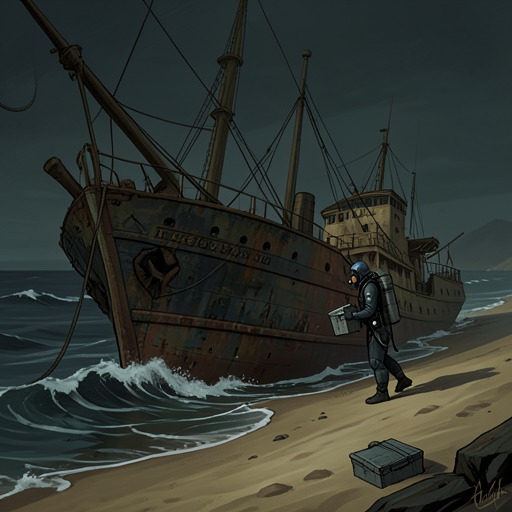
Shipwrecked state of the vessel on Hemlock Bluff
Young Captain Jack · The Son of a SoldierThe shipwrecked state of the vessel on Hemlock Bluff is the novel’s most important landscape of buried evidence. The stranded ship is not merely a relic of disaster: it is the place where Jack Ruthven was found as a child, where the surviving traces of his family were left behind, and where the black tin box containing Colonel Stanton’s papers was eventually recovered. Its ruined condition conceals the truth while repeatedly drawing the characters back to it, making the wreck a bridge between traumatic memory, disputed parentage, and restored family fortune.
Disaster and Physical Condition
The wreck came ashore on the rocks of Hemlock Bluff between ten and eleven years before Jack and Marion Ruthven investigate it. During the storm, a signal gun announced that the ship was in distress; the vessel then appeared rocking violently while waves swept across its deck. No one remained aboard: the captain and crew had gone down in the ocean. The ship’s destruction therefore forms the first known setting of Jack’s life, linking his identity from the beginning to a catastrophe in which his family was separated and presumed lost.
By the time Jack reaches the vessel, its bow is raised well onto the rocks while its stern projects over the sea. The deck has decayed so badly that Jack and Marion must move cautiously, and reaching it is difficult even for Jack, who is a capable climber. The wreck’s unstable position gives the investigation a physical danger that matches its emotional stakes: the characters are searching for the past on a structure already surrendering to the sea.
The ruin is later struck by lightning. The bolt tears away a large section of the stern woodwork and travels along one side of the vessel, while a fire begins just below the deck line. Old Ben recognizes that the wreck is about to burn, and Jack, Marion, and Old Ben leave in the rain, grateful that their lives have been spared. The fire further transforms the ship from a damaged survivor into an endangered archive, threatening to destroy the remaining evidence even as it exposes hidden parts of the vessel.
Jack Ruthven’s Rescue and Fragmented Memory
The wreck’s most intimate connection is with Jack Ruthven’s childhood rescue. Old Ben, then enslaved by the Ruthven family, was watching on the bluff when he heard a cry of pain after the wreck came ashore. On the beach he found an injured woman—Jack’s mother—with the three- or four-year-old boy in her arms. Jack cried that he was hungry and asked for bread and butter. Old Ben carried the child and his mother to the boathouse, then went to the plantation for help; Martin Ruthven and several men returned with him and brought both survivors to the house.
Jack retains only a dim impression of the event: a storm, enormous waves, and an atmosphere he describes as dreamlike. The wreck thus functions as a trigger for incomplete memory rather than as a simple source of information. His personal recollection is fragmentary, while Marion Ruthven’s account and the physical objects preserved by Alice Ruthven supply external testimony. The contrast makes the vessel a site where memory must be tested against witnesses and material remains.
The wreck also explains why Jack’s identity initially appears to have no recoverable origin. His mother died after the rescue, and no one could establish the family’s name. Her clothing bore no mark, and the only item in her pocket was an unmarked lace handkerchief. Alice Ruthven kept the handkerchief and clothing, along with a ring from the woman’s finger. The ring had once carried an inscription, but it was so worn that neither of two jewelers could read it. The wreck therefore leaves behind traces that are tangible but initially indecipherable: objects exist, yet they do not immediately yield a name.
The Search for Hidden Evidence
The wreck’s ruined interior becomes an investigative space when Dr. Mackey visits it in search of the ship’s stateroom numbered fifteen. He climbs onto the charred deck, descends into the main cabin with a candle, and searches for the room despite the fire damage. In a closet roughly a foot square and equally deep, dirt and water have formed a solid cake. By digging through it, he uncovers a heavy black-painted tin box secured by a small padlock. He tries keys from his pocket until one opens it and celebrates the discovery.
This search reveals that the vessel has been more than a scene of loss. It has also been a hiding place for documents valuable enough to motivate criminal pursuit. Dr. Mackey’s interest in the wreck is connected to the property that belongs to Colonel Stanton and his family. The ship’s decay conceals the box, but it does not erase it; the hidden compartment converts the wreck from a memorial of disaster into a repository of legal and financial proof.
The box later reappears after the guerrilla camp that held Jack captive is searched. The outlaws’ goods include property stolen from a trader as well as the tin box taken from the wreck of the Nautilus. The box is turned over to Colonel Stanton, who recognizes the papers as his precious documents and tells Jack that nothing now stands between them and their fortune. Recovery from the wreck consequently completes a chain that began with concealment: the ship’s hidden evidence survives fire, theft, and criminal possession long enough to restore the family’s claim.
Reinterpretation of the Wreck
The wreck’s meaning changes as the novel’s competing identity claims are exposed. At first, it supports the story that Jack is an unknown child who does not belong to the Ruthven family. Marion instead confirms that the Ruthvens adopted him when he was three or four and that he is legally her brother. The wreck then supplies the earlier, unresolved layer of his history: he is not simply an adopted child of unknown origin, but a survivor found beside a dead or dying family narrative.
Dr. Mackey later claims that Jack is his son, calling him his boy and asserting that the boy’s resemblance to Walter proves the connection. That claim is placed against the wreck’s evidence and against the history of the ship’s passengers. Dr. Mackey explains that he had been separated from his wife and little son during the disaster, though his claim is ultimately exposed as part of his attempt to obtain property. Colonel Stanton’s fevered speech provides a more credible parallel: he cries that the ship is doomed and asks that his wife Laura and his son Jack be saved. The resemblance between Colonel Stanton and Jack, together with the reference to Laura, reactivates the wreck as evidence of a genuine father-and-son separation.
Colonel Stanton’s recovered account deepens the disaster’s consequences. He was swept overboard before the ship entered the bay, clung to a spar for hours, and was rescued by a passing vessel bound for Cuba. Exposure damaged both his body and his mind; after a hospital stay he was transferred to an insane asylum, where he remained for years. His later testimony confirms that he, his wife, and their little son had taken passage on the ship, and that he learned only recently that the wreck on Hemlock Bluff was their vessel. The wreck thus explains not only Jack’s abandonment but also the prolonged absence, impaired memory, and delayed recognition that keep father and son apart.
Narrative Significance
The shipwrecked state of the vessel on Hemlock Bluff concentrates the novel’s major conflicts in one physical object: life against death, memory against oblivion, adoption against biological parentage, and honest recovery against criminal appropriation. Its broken hull preserves several kinds of evidence at once—the childhood scene remembered by Jack, the ring and handkerchief kept by Alice Ruthven, and the black tin box containing Colonel Stanton’s papers. Each return to the wreck changes the value of what it contains, moving the narrative from rumor to investigation and finally toward recognition.
The wreck also gives the story a recurring structure of delayed revelation. It first appears as a visible landmark that prompts Marion to tell Jack where he came from; later it becomes a dangerous site of exploration, a burning remnant, and a target for Dr. Mackey’s search. Its repeated reappearance does not merely repeat the same mystery. Each encounter adds a different form of proof, until the ship’s destruction can be read as the beginning of a family history rather than its final end. In that sense, the wreck remains physically ruined but narratively active: what the sea and fire failed to preserve openly survives in fragments, objects, testimony, and recovered papers.